

Power, water and land will decide where Australia’s data centres go. New national and state rules now settle who pays for most of the connection costs. Governments have said much less about where the next wave should go, and preparing sites at retiring coal and industrial locations is the next step.
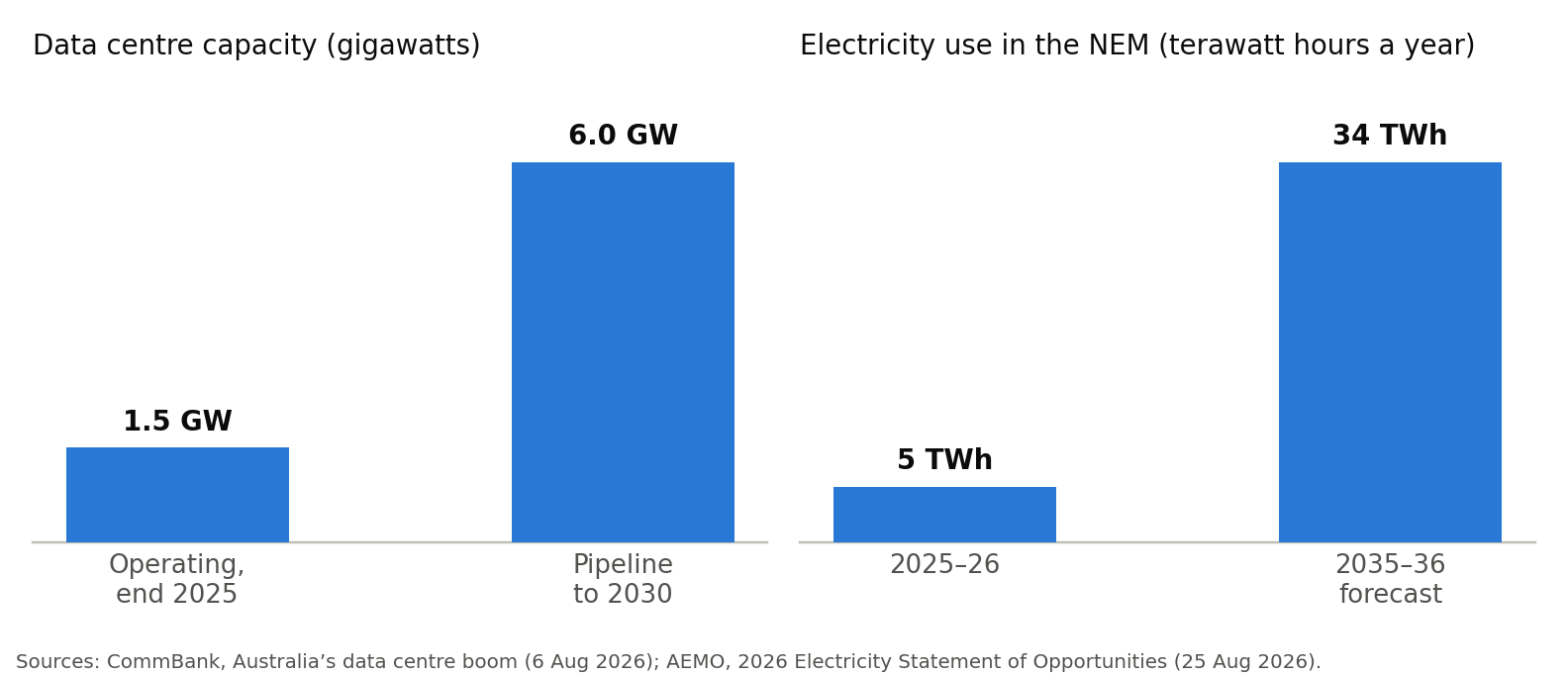
Australia had 162 operational data centres with about 1.5 gigawatts of capacity at the end of 2025, only three of them above 100 megawatts, and the pipeline to 2030 is about 6 gigawatts, four times current capacity.1 AEMO forecasts that data centres in the National Electricity Market will use about 34 terawatt hours a year by 2035–36, up from about 5 terawatt hours in 2025–26, lifting their share of supply from around 3 to 13 per cent while about 15 gigawatts of coal and gas generation retires (Figure 1).2
The pressure is sharpest in New South Wales. Data centres there are seeking connections totalling up to 28 gigawatts, against average daily demand of 7.5 to 10 gigawatts, and more than 90 per cent of that pipeline wants to connect in the Sydney–Newcastle–Wollongong region. Transgrid has told proponents that no transmission capacity will be available for new connections in Western Sydney beyond 2033.4 The location of the next facilities will determine what they cost the electricity and water systems, and how quickly Australia gains from them.
What governments have already put in place
The Commonwealth published its expectations of data centre developers in March,5 and in August National Cabinet agreed to consistent mandatory standards for energy, water and land use, with Commonwealth legislation intended for early 2027.6 The standards are not expected to be retrospective, so 27 approved projects with at least 3.38 gigawatts of capacity will proceed under current rules.7 The Australian Energy Market Commission has advised that data centres should bring new renewable and firm supply and be flexible,8 and is consulting on rules to stop connection costs shifting to other customers.9
The states are going further. NSW commits to assess compliant projects within 75 days10 and proposes entry bonds, take-or-pay payments for network capacity, a competitive access scheme for large loads, and a network upgrade fee of $200,000 per megawatt in Sydney–Newcastle–Wollongong against $100,000 elsewhere.11 Victoria prohibits data centres in rural zones unless they sit near major transmission, substations, renewable generation, batteries or recycled water, and expects evaporative cooling to use recycled or non-drinking water.12 South Australia requires facilities of 100 megawatts or more to pay for all network augmentation.13
These rules largely settle who pays, and the NSW fee differential already points investment away from Sydney. They say much less about where the next large campuses should go, and who prepares those sites.
Power and water decide location
Newer facilities increasingly use closed-loop and direct-to-chip liquid cooling, and the water needed for the same computing output can vary by a factor of 10,000 depending on the cooling system.14 A cool climate still lowers energy use, but across most of southern and eastern Australia the cooling design determines water use more than the weather does.
The tighter constraint is firm electricity and spare transmission capacity. Tasmania has the coolest climate, hydro power and plentiful water, yet Hydro Tasmania has said that a 450 megawatt request from one developer, about 30 per cent of the state’s consumption, would require new wind and solar generation to be built.15
Some developers plan to generate their own power on site. The AEMC advice supports co-locating generation and storage through connection agreements, and Project Ares in the Northern Territory proposes to run entirely off-grid on up to 3 gigawatts of solar, a 16 gigawatt-hour battery and about 1 gigawatt of gas.16 On-site supply shortens the wait for a connection and keeps network costs away from households, but a site meeting a flat, around-the-clock load from its own generation loses the benefit of the shared grid, and large on-site gas plants compete with households for gas.17 A site that keeps a grid connection as backup should pay for that standby capacity.
Coal’s exit leaves useful assets behind
Coal power stations sit at the strongest points of the grid, with high-voltage connections, industrial land, water entitlements, road and rail access and an experienced workforce. Three of the four remaining coal-fired power stations in NSW are expected to close by 2033, and together they generated around half of the state’s electricity in 2026.18 AGL plans to repurpose the land, water access, transport links and grid connections at its Liddell and Bayswater sites for co-located industries.19 The NSW Government has exhibited master plans for the Mt Arthur coal mine, which closes in 2030, citing its existing power, water, road and rail infrastructure.20 Coal mines in the Hunter hold about 47 gigalitres of water licences, including 55 per cent of the region’s high security licences.21
Locating data centres on these sites reuses network assets that consumers have already paid for, which lowers the cost to the whole system. Water needs care. Rehabilitating the Latrobe Valley’s three brown coal mines is estimated to need about 2,354 gigalitres, while long-term water available from the Latrobe system fell from about 800 to 600 gigalitres a year between 1997 and 2017.22 Data centres in coal regions should use closed-loop or dry cooling and receive water only where they do not compete with rehabilitation or town supply.
Retiring coal sites also keep options open for other firm generation. All seven sites proposed for nuclear plants in 2024 were retiring or retired coal sites, chosen for their cooling water and transmission,23 although nuclear power remains prohibited under federal and some state laws, and CSIRO estimates at least 15 years from removing those barriers to first generation.24 Nuclear cannot supply the current wave of demand, but the sites keep their value for whatever firm generation follows.
The regions best placed
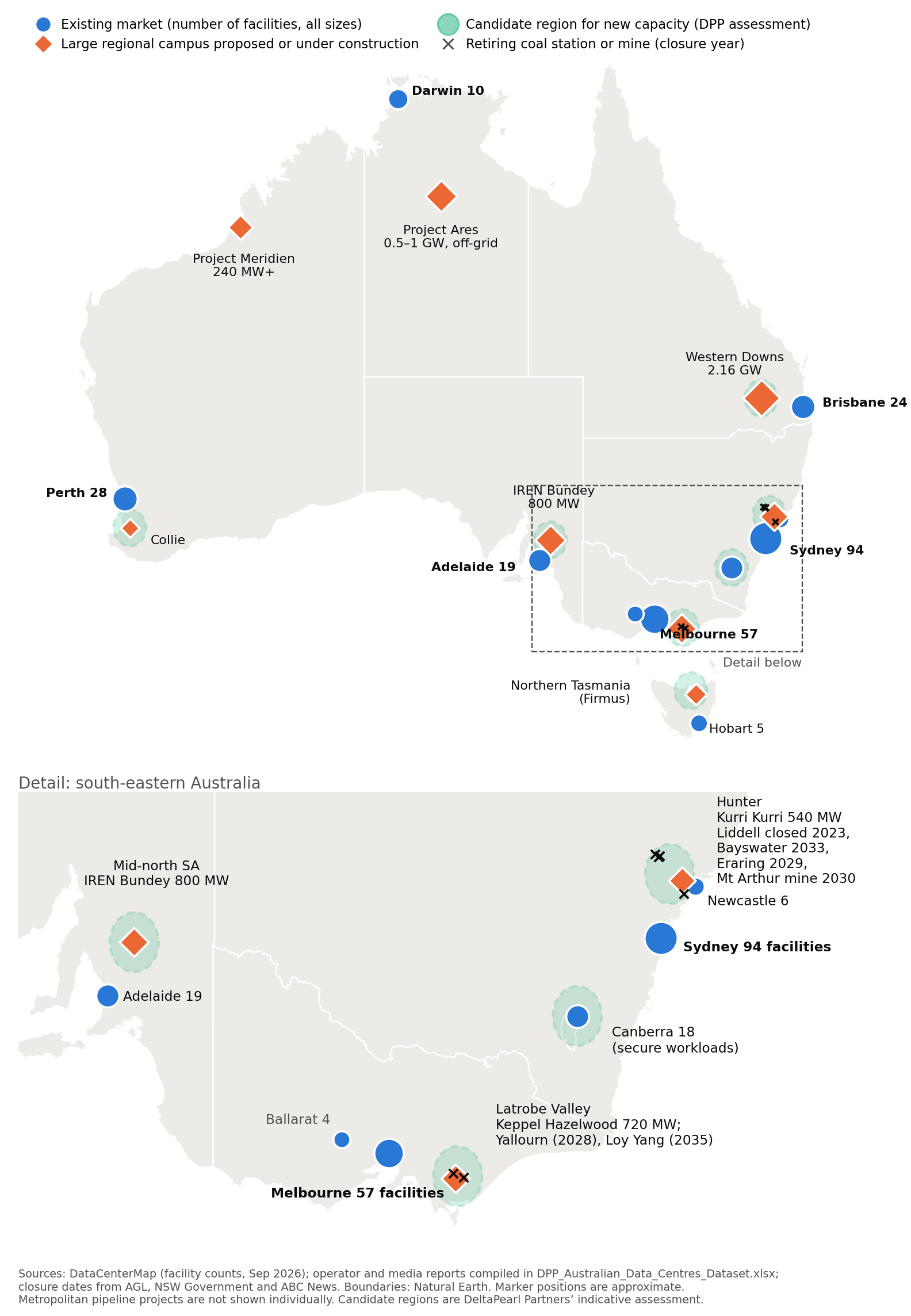
Three regions combine strong grid connections, room to grow and proximity to a capital city (Figure 2). In Victoria’s Latrobe Valley, Keppel has proposed a A$10 billion, 720 megawatt campus at Hazelwood, citing one of the state’s largest electricity nodes, the proposed Gippsland Renewable Energy Zone, non-potable cooling water and low-latency fibre.25 In the Hunter, AirTrunk plans a 540 megawatt, dry-cooled campus on the former Kurri Kurri aluminium smelter site, opening in 2028.26 In South Australia, IREN plans an 800 megawatt campus at Bundey, about 125 kilometres north-east of Adelaide, served by four 330 kilovolt feeders without network upgrades and due to begin energisation from 2028.27 Water is scarce in the mid-north, so dry cooling will be needed there.
Other regions suit particular roles. Queensland’s proposed Western Downs Digital Park would connect directly to a major substation beside gas, solar and wind generation, although at 2.16 gigawatts it could add about a quarter to the state’s daily electricity use.28 Canberra’s cool climate and government customers suit secure workloads, but the ACT’s peak demand of 732 megawatts limits scale.29
Some data centres near cities, some further away
Distance matters less than many assume. A signal in optical fibre travels about one kilometre every five microseconds,31 so a site 150 kilometres from a capital adds about 1.5 milliseconds to a round trip. AI training can tolerate delays of up to 100 milliseconds between regions,32 so training and bulk processing can run at regional energy sites with no noticeable loss of performance.
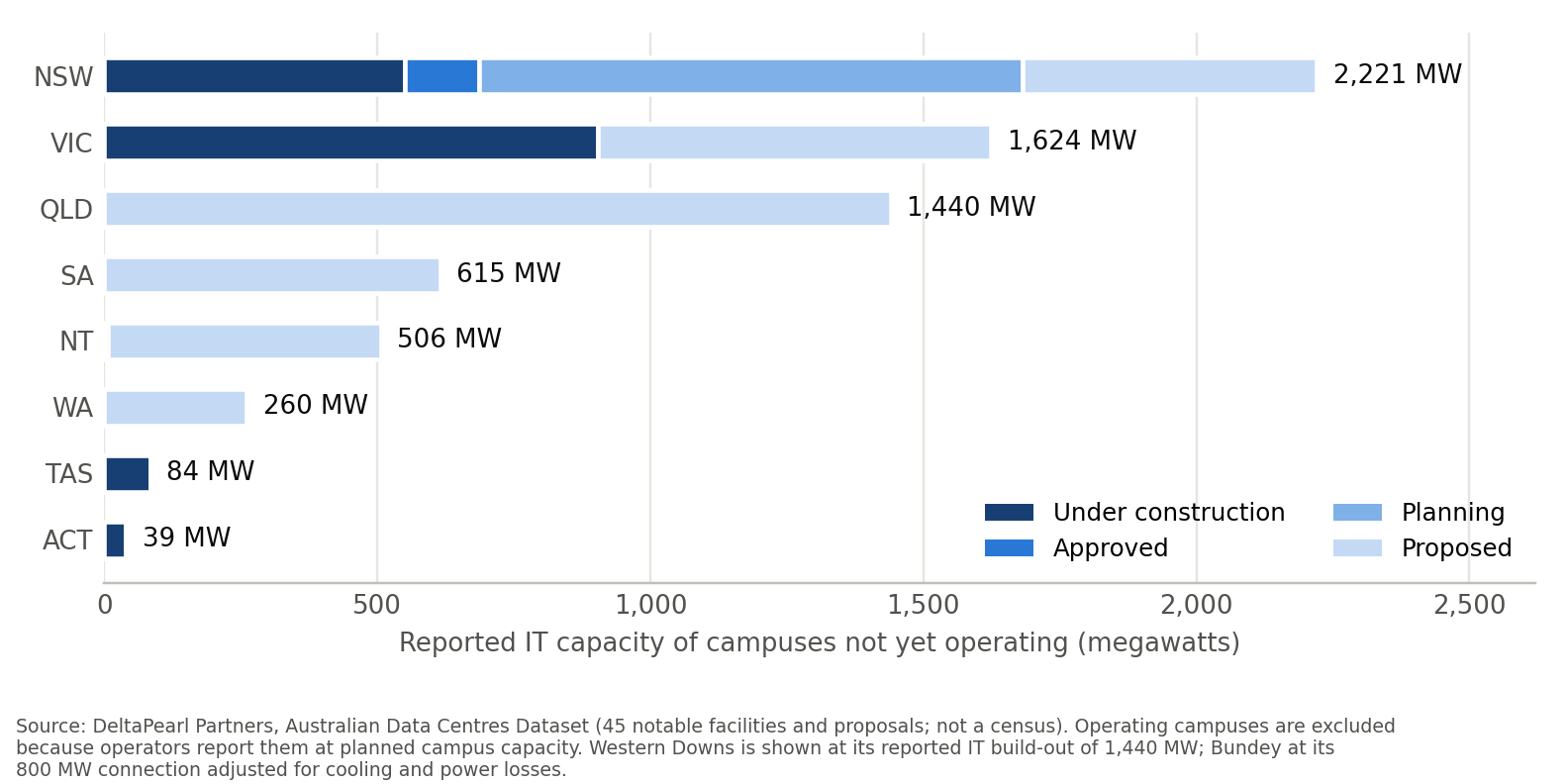
Some capacity belongs in the cities. Payments, trading and fraud detection need very low delay, and AI inference cannot be cached in advance the way streamed video can, so growing use of AI requires more computing close to users.33 Interconnection also gains value as networks cluster, as Northern Virginia shows.34 But each additional city facility adds less speed and more cost as land, grid capacity and water run short, the pattern NSW now faces in Western Sydney. Most of the pipeline is still headed for NSW and Victoria, and most of it is at the planning or proposal stage (Figure 3).
Darwin shows the city end of this pattern at small scale. It has about ten facilities,35 including one of up to 7 megawatts, serving defence, government and links to Asia. The Darwin–Jakarta–Singapore cable gives a direct fibre route to Singapore, and the NT Government places Darwin within 50 milliseconds of more than 500 million people.36 Those advantages justify small, well-connected facilities near users and cables. They do not make the tropics a low-cost location for gigawatt-scale training, which depends above all on firm power and efficient cooling. The efficient pattern is metropolitan and gateway facilities for latency-sensitive work, and large campuses at regional energy nodes, joined by fibre.
How governments can help and recover the cost
Several useful tools are already in train. NSW’s take-or-pay proposal and upgrade fee put more of the network cost on the data centre, and Victoria has a single Investment Front Door and is scoping renewable energy industrial precincts.37 Five further steps would complete the approach.
First, states can prepare precincts on retiring coal and industrial land before seeking tenants, with land, approvals, grid and water planned as one package. NSW’s master plans for former mine land target renewable energy, advanced manufacturing and logistics;38 data centres could be added where power and water allow.
Second, states can allocate precinct sites competitively and lease public land at a market rent, as NSW already allocates access to renewable energy zones.39 A long-term ground lease with indexed rent returns value to the public from a base that cannot move offshore.
Third, state utilities can build the generation, connections and water infrastructure a precinct needs ahead of demand, and recover the cost from users. Assets built for one tenant should be recovered over that tenant’s contract through take-or-pay payments backed by security; shared assets can be recovered over their full life. NSW proposes a 10-year minimum for network payments and has asked whether that is long enough.40 Servers turn over quickly, with Microsoft depreciating its cloud servers over six years,41 while generators and transmission last for decades. Tomago shows the risk of relying on one large user: the federal and NSW governments have committed A$2.5 billion over ten years to keep the smelter operating.42
Fourth, prices should cover the full commercial cost, including a return that reflects the risk, consistent with competitive neutrality principles,43 with oversight by the state’s independent price regulator and published terms. Spare capacity in existing assets can be sold on the same basis. Adelaide’s desalination plant can produce up to 100 gigalitres a year44 but typically produces about 5.3 gigalitres.45 An interruptible water tariff for data centres able to switch to dry cooling in drought would earn a return on an asset households already fund.
Fifth, national principles should stop states competing through cheap land and hidden subsidies, which moves value from taxpayers to investors without adding to national investment. National Cabinet has already allowed Queensland to use any technology, including coal and gas, to supply data centres,46 which shows how quickly settings can diverge.
What faster action is worth
The investment is already large. Businesses in the information, media and telecommunications industry expect to spend A$19.2 billion in 2025–26, up 51.7 per cent, in a series the ABS identifies as strongly influenced by data centre activity.47 The Reserve Bank Governor told a parliamentary committee in September that business investment growth has picked up strongly, driven mostly by data centres and renewable energy projects.48 Operators have raised A$35 billion so far in 2026, about 85 per cent as debt,49 a further reason to leave the risk of underused assets with investors.
The larger gain comes from use. The Productivity Commission estimates that AI could lift multifactor productivity by more than 2.3 per cent over the next decade and add about A$116 billion to GDP.50 Onshore capacity supports the latency-sensitive and data-residency uses that help firms and governments adopt AI. Speed has value because capital is mobile: each year of delay defers the returns on investment and adoption, and gives competing markets time to secure the same tenants.
Coal regions would gain a new use for land, grid connections and skills, and governments would gain lease and rates revenue, although data centres employ relatively few people once built. Governments that prepare sites, build shared infrastructure early and charge users its full cost will attract investment sooner and at lower cost to the energy system, without asking households to carry the risk. DeltaPearl Partners models energy networks, water pricing and regional economic effects, and welcomes discussion with governments, utilities and investors working on these decisions.
Notes
- CommBank, “Australia’s Data Centre Boom: A $150 Billion Investment Opportunity,” August 6, 2026. ↩
- AEMO, “2026 Electricity Statement of Opportunities,” media release, August 25, 2026. ↩
- CommBank, “Australia’s Data Centre Boom.” AEMO, “2026 Electricity Statement of Opportunities.” ↩
- NSW Department of Climate Change, Energy, the Environment and Water, Reforming Electricity Network Connection and Cost Recovery Arrangements for Data Centres in NSW, consultation paper, August 2026. ↩
- Department of Industry, Science and Resources, Expectations of Data Centres and AI Infrastructure Developers, March 2026. ↩
- National Cabinet, “Meeting of National Cabinet,” August 26, 2026. ↩
- ABC News, “The AI Data Centres Set to Escape Planned Restrictions,” September 11, 2026. ↩
- Australian Energy Market Commission, “Data Centres to Bring Clean, Firm Energy, Be Flexible and Pay Their Way, AEMC Advises Ministers,” August 5, 2026. ↩
- Australian Energy Market Commission, “Cost Recovery for Network Augmentations, Package 1 (ERC0448),” 2026. ↩
- NSW Government, “Nation-Leading Framework to Harness NSW Data Centre Investment,” August 2026. ↩
- NSW Department of Climate Change, Energy, the Environment and Water, Reforming Electricity Network Connection and Cost Recovery Arrangements. ↩
- Victorian Government, The Sustainable Data Centre Action Plan, 2026. ↩
- NSW Department of Climate Change, Energy, the Environment and Water, Reforming Electricity Network Connection and Cost Recovery Arrangements. ↩
- Water Services Association of Australia, Data Centres and Water in Australia, December 2025. ↩
- ABC News, “Hydro Tasmania to Decide by End of Year on Firmus’s Request for 450 MW,” September 4, 2026. ↩
- DatacenterDynamics, “Gigawatt-Scale Behind-the-Meter Data Center Campus Proposed in Australia’s Northern Territory,” 2026. ↩
- Utility Dive, “Behind-the-Meter Data Center Gas Plants Will Raise US Energy Bills,” June 8, 2026. ↩
- NSW Department of Climate Change, Energy, the Environment and Water, Reforming Electricity Network Connection and Cost Recovery Arrangements. ↩
- AGL, “AGL in the Hunter Region,” 2026. ↩
- NSW Department of Planning, Housing and Infrastructure, “Securing the Hunter’s Future: Jobs and Investment from Mining Land Reuse,” 2026. ↩
- Bioregional Assessments, Current Water Accounts and Water Quality for the Hunter Subregion, Australian Government. ↩
- ABC News, “Victorian Coal Mine Operators Urged to Pay for Vast Amount of Rehabilitation Water,” July 25, 2025. ↩
- ABC News, “Peter Dutton Reveals Seven Sites for Proposed Nuclear Power Plants,” June 19, 2024. ↩
- CSIRO, “Nuclear Explainer,” December 2024. ↩
- ABC News, “$10 Billion Data Centre Planned for Hazelwood in Victoria’s Latrobe Valley,” January 22, 2026. ↩
- Newcastle Herald, “AirTrunk’s $5 Billion Kurri Data Centre Includes a $37 Million Community Infrastructure Fund,” September 2026. ↩
- IREN, “IREN Announces First Australian Data Center Campus: 800MW in South Australia,” June 3, 2026. ↩
- ABC News, “Australia’s Largest Proposed Data Centre Could Draw a Quarter of Queensland’s Energy Use,” September 14, 2026. ↩
- ABC News, “Why Canberra Is a Data Centre Hotspot,” August 23, 2026. ↩
- DataCenterMap, “Australia Data Centers,” 2026. ↩
- M2 Optics, “Calculating Optical Fiber Latency.” ↩
- DatacenterDynamics, “Training Built the Campuses. Inference Will Choose the Markets,” 2026. ↩
- The Conversation, “Data Centres in Australia: Your Questions Answered,” 2026. ↩
- Federal Reserve Bank of Richmond, “Virginia’s Data Centers and Economic Development,” Econ Focus, Q2 2023. ↩
- DataCenterMap, “Australia Data Centers.” ↩
- Northern Territory Government, “Digital Infrastructure: Why Invest in the NT.” ↩
- Victorian Government, Sustainable Data Centre Action Plan. ↩
- NSW Department of Planning, Housing and Infrastructure, “Securing the Hunter’s Future.” ↩
- EnergyCo NSW, “Central-West Orana Renewable Energy Zone Access Scheme.” ↩
- NSW Department of Climate Change, Energy, the Environment and Water, Reforming Electricity Network Connection and Cost Recovery Arrangements. ↩
- The Register, “Microsoft Extends Life of Cloud Servers to Six Years,” August 2, 2022. ↩
- ABC News, “Federal and NSW Governments to Split $2.5 Billion Tomago Aluminium Bailout,” August 12, 2026. ↩
- Treasury, Commonwealth Competitive Neutrality Policy Statement. ↩
- Australian Water Association, “SA Desal Plant Returns to Normal Operating Mode after Key Role in Water for Fodder Program,” 2020. ↩
- ABC News, “Lonsdale Desalination Plant to Quadruple Output as Reservoirs Drop to 20-Year Low,” January 27, 2025. ↩
- ABC News, “Queensland Allowed to Use Coal, Gas for Data Centres despite Renewable Push,” August 26, 2026. ↩
- Australian Bureau of Statistics, “Spotlight on Data Centres in Economic Statistics,” 2026. ↩
- Reserve Bank of Australia, “Opening Statement to the House of Representatives Standing Committee on Economics,” September 18, 2026. ↩
- ABC News, “Data Centre Funding Surges to Record $35b This Year despite AI Bubble Risks,” September 23, 2026. ↩
- Productivity Commission, Harnessing Data and Digital Technology, December 2025. ↩